
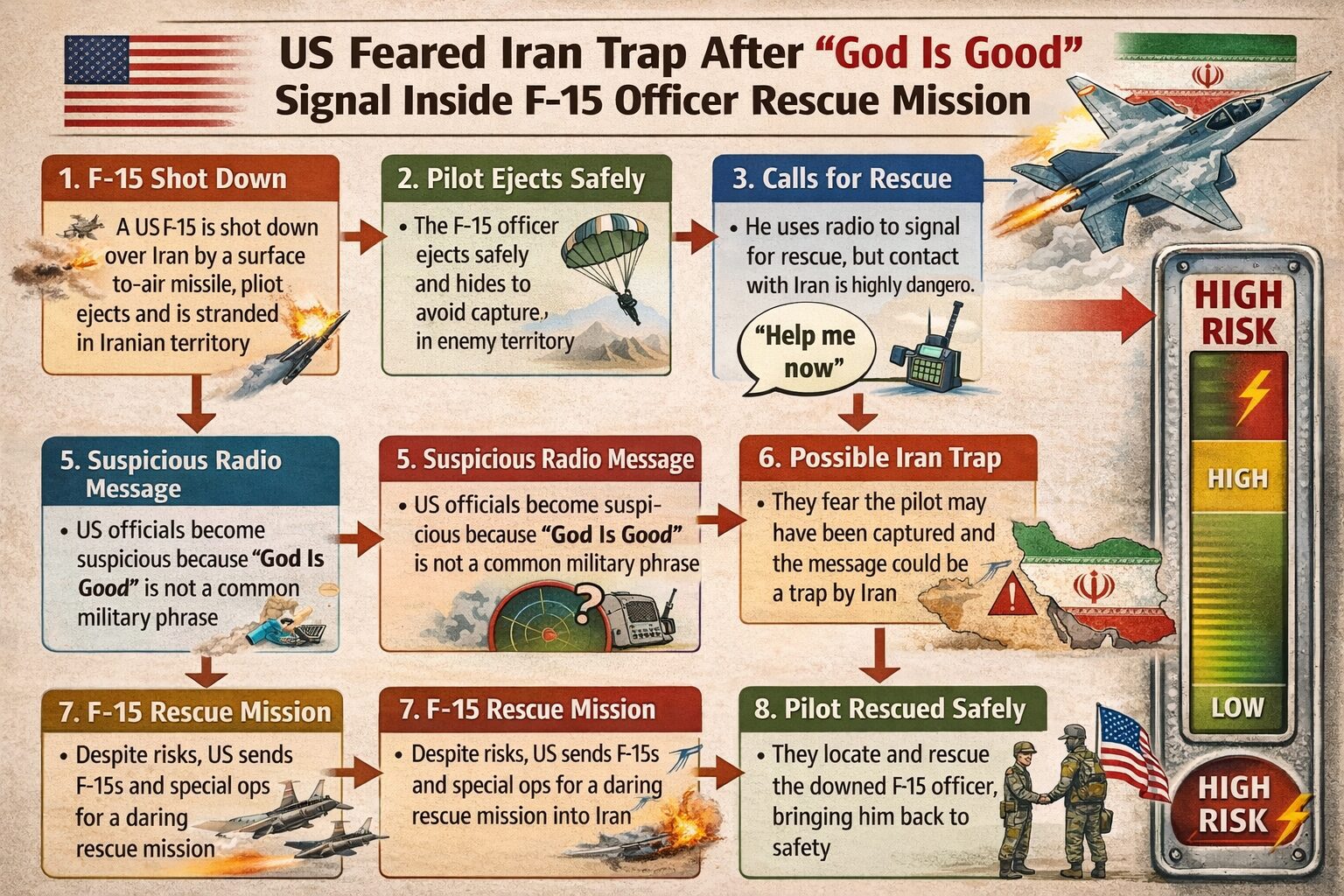
Iran War 2026: How a 3-Word Radio Message Nearly Stopped F-15 Officer Rescue
Background: F-15 Shot Down Over Iran
The incident took place during an ongoing conflict between the United States and Iran, F-15 Officer Rescue Mission which had already escalated into active military confrontation. An American F-15E Strike Eagle fighter jet was shot down over southwestern Iran.
This was a serious situation because:
- It was one of the first confirmed U.S. fighter losses inside Iran
- Two crew members were onboard:
- The pilot
- The weapons systems officer (WSO)
Both ejected safely, but landed in hostile territory controlled or monitored by Iranian forces.
The Strange Radio Message: “God is Good”
After ejecting and hiding in mountainous terrain, the stranded officer managed to send a short radio signal back to U.S. command:
???? “God is good”
At first glance, this sounds like a normal emotional or spiritual message. However, in a high-risk war zone, this raised immediate suspicion.
Why did the U.S. suspect a trap?
According to reports:
- The message was unexpected and unusually phrased
- Officials feared:
- It could be sent by Iranian forces pretending to be the pilot
- Or the officer might have been captured and forced to transmit it
- The religious tone also stood out and triggered doubts among analysts
In military operations, especially behind enemy lines, even a single unusual word can change decisions. A rescue team entering a trap could result in:
- Loss of special forces
- Captured U.S. personnel
- Major escalation of war
Because of this, the U.S. initially hesitated to launch the rescue mission.

Why the Situation Was So Dangerous
The downed officer was in extreme danger:
- He was injured and alone
- Hiding in mountainous terrain
- Being actively hunted by:
- Iran’s Islamic Revolutionary Guard Corps (IRGC)
- He had limited resources:
- A handgun
- A survival radio
- A tracking beacon (used carefully to avoid detection)
At the same time, Iran was trying to capture him alive, which would have been a huge propaganda and strategic victory.
U.S. Intelligence Verification
Before launching the rescue, the U.S. had to confirm:
- Was the message truly from the officer?
- Or was it a deception?
To solve this, intelligence agencies like the CIA stepped in:
- They used advanced surveillance and tracking technology
- Verified the officer’s exact location
- Cross-checked communication patterns
- Monitored Iranian troop movements nearby
Only after confirming the signal was genuine did the U.S. decide to act.
CIA Deception Strategy
Interestingly, the U.S. didn’t just react — it played its own deception game.
The CIA launched a covert misinformation campaign:
- Spread false information that:
- The pilot had already been rescued
- This confused Iranian forces
- Diverted them away from the actual location
This tactic bought critical time for U.S. forces to prepare the real rescue mission
The High-Risk Rescue Operation
Once the signal was verified, the U.S. launched one of the most dangerous rescue missions in recent history.
Key elements of the operation:
- Special Forces involvement (including elite units like SEAL Team 6)
- Hundreds of personnel
- Multiple aircraft:
- Helicopters (e.g., Black Hawks)
- Drones (MQ-9 Reapers)
- Transport planes
What happened on the ground:
- The officer hid for over 36–48 hours
- U.S. forces entered deep into Iranian territory
- A firefight broke out with Iranian forces
- Airstrikes were used to protect the rescue team
Despite:
- Heavy resistance
- Damaged aircraft
- Extreme risk
???? The mission succeeded without U.S. fatalities
Two Separate Rescues
Important detail:
- The pilot was rescued first
- The weapons systems officer (the one who sent the message) was rescued later
Both were successfully extracted, marking a rare full recovery in such hostile conditions.
Why the “Trap Suspicion” Matters
This incident highlights how modern warfare works:
1. Information is as important as weapons
A simple phrase like “God is good” nearly stopped the mission.
2. Deception is everywhere
Both sides were:
- Trying to mislead each other
- Using intelligence and psychology as tools
3. Risk vs Reward Decisions
The U.S. had to decide:
- Save one soldier immediately
OR - Risk losing an entire rescue team
Political and Military Impact
The successful rescue had major consequences:
- Boosted morale for the U.S. military
- Showed capability to operate inside Iran
- Increased tensions further in the war
Leaders described it as:
???? “One of the most daring rescue operations in U.S. history”
At the same time:
- Iran claimed it shot down additional U.S. aircraft
- The conflict continued to escalate
Conclusion
The “God is good” radio message became a powerful symbol of this operation. What seemed like a simple statement almost changed the course of a critical military decision.
US military rescue mission Iran trap suspicion God is good radio message F-15 crash rescue story US Iran conflict news special forces rescue operation CIA deception Iran breaking world news 2026 military survival story God is good radio message US military US feared Iran trap F-15 rescue F-15 crash rescue mission Iran US special forces rescue operation 2026 Iran war breaking news 2026 CIA deception Iran rescue mission US military survival story F-15 pilot Iran vs US conflict latest news F-15 officer rescue story Iran F-15 Officer Rescue Mission