
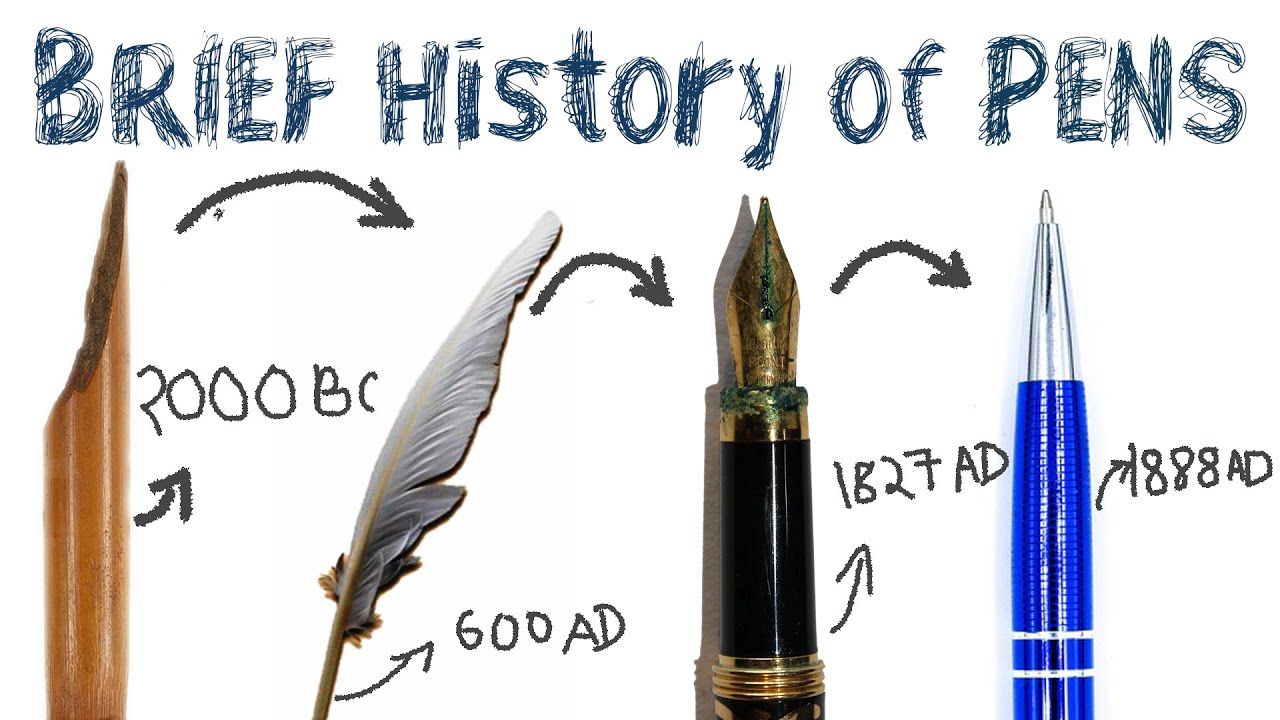
The history of the first pen is a fascinating journey through human ingenuity, evolving from simple tools to sophisticated writing instruments. The term “pen” derives from the Latin *penna*, meaning feather, reflecting early writing tools. This account traces the development of the pen, focusing on the first pens and their evolution, with hints to key milestones and inventors, culminating in a comprehensive 700-word narrative.
Early Writing Tools (Pre-3000 BCE) (History of First Pen)
The concept of a pen emerged when humans began recording information. The earliest “pens” were not pens as we know them but tools like sharpened sticks, bones, or reeds used to inscribe clay tablets or scratch marks on surfaces. Mesopotamian cuneiform (circa 3000 BCE) used reed styluses to press wedge-shaped marks into wet clay, one of the earliest writing systems.
– These styluses, often cut from river reeds, were dipped in natural pigments or left marks directly. They were simple, requiring no ink reservoir, but limited to specific surfaces like clay or wax.

Reed Pens (circa 2500 BCE–1000 CE)
The Egyptians advanced writing with **reed pens** around 2500 BCE, used on papyrus. These pens, made from hollow reeds or bamboo, had tips cut to a point or split to hold ink made from soot, water, and gum. The Rosetta Stone (196 BCE) was likely inscribed using reed pens, showcasing their role in ancient administration.
– Reed pens were versatile, used across Mesopotamia, Egypt, and later Greco-Roman cultures. Writers dipped the pen in ink repeatedly, as it lacked a reservoir, making it labor-intensive but effective for hieroglyphs and early scripts.
Quill Pens (600 CE–1800s)
The **quill pen**, introduced around the 6th century CE, marked a significant leap. Made from bird feathers (typically goose or swan), quills were lightweight, flexible, and could be sharpened to a fine point. Medieval monks used quills to copy manuscripts, such as the Lindisfarne Gospels (circa 715 CE).
– The quill’s hollow shaft held a small amount of ink, applied by dipping in an inkwell. Its flexibility allowed varied line widths, ideal for calligraphy. By the Middle Ages, quills dominated Europe, used by figures like Shakespeare. However, they required frequent sharpening and were prone to wear, necessitating constant maintenance.
Metal Nibs and Early Fountain Pens (1700s–1800s)
By the 18th century, the quest for durability led to **metal nibs**. Early metal pens, like those crafted in the 1700s, were rigid and less practical than quills but laid groundwork for modern pens. In 1809, Peregrine Williamson patented an early metal pen in the U.S., though it was not widely adopted.
– The first true fountain pen, with an internal ink reservoir, emerged in the early 19th century. In 1827, **Petrache Poenaru**, a Romanian inventor, patented a fountain pen with a barrel holding ink, fed to a quill or metal nib via a simple mechanism. Poenaru’s design, registered in France, is considered one of the earliest fountain pens, though rudimentary.
– These early fountain pens were unreliable, prone to leaks and inconsistent ink flow. By the 1850s, manufacturers experimented with gold nibs and rubber reservoirs to improve performance.
The Fountain Pen Revolution (1880s)
The modern fountain pen took shape in the 1880s, largely due to **Lewis Waterman**, an American inventor. In 1884, Waterman patented a fountain pen with a capillary feed system, ensuring steady ink flow without leaks. Waterman’s inspiration came after a leaky pen ruined a contract, driving him to create a reliable design.
– His pen used a metal nib, an ink reservoir, and a feed mechanism that balanced air and ink flow. This made fountain pens practical for everyday use, revolutionizing writing for professionals and students. Companies like Parker and Sheaffer further refined designs, introducing features like button fillers and lever fillers by the early 20th century.
Photo Context
While no specific images of the “first pen” exist due to its ancient origins, related visuals include:
– Reed Pen Artifacts: Photos of Egyptian reed pens in museums (e.g., British Museum) show their simple, hollow structure.
– Quill Pens: Images of medieval manuscripts often depict quills, as in illuminated texts.
– Waterman’s Patent: Diagrams from Waterman’s 1884 patent (available online) illustrate the fountain pen’s feed system.
– Photo Requirement: For visa-like applications (per your prior queries), a modern passport photo (35x45mm, white background, neutral expression) is unrelated but could be used for historical documentation submissions. Use tools like PhotoGov for compliance.
Later Developments
The fountain pen dominated until the 20th century when **László Bíró**, a Hungarian journalist, invented the ballpoint pen in 1938.Bíró’s ballpoint, patented in Argentina, used a rolling ball to dispense quick-drying ink, inspired by newspaper printing presses.
– Commercialized by Bic in the 1950s, ballpoints overtook fountain pens for convenience. However, fountain pens remain popular for their elegance and are still produced by brands like Montblanc.
Significance and Legacy
The pen’s evolution reflects humanity’s need to communicate. From reed styluses to Waterman’s fountain pen, each innovation addressed limitations of its predecessor. The Subclass 462 visa process (from your prior query) requires photos, but historical pen documentation does not; still, understanding this history enriches appreciation for writing’s tools. The Pen Museum in Birmingham, UK, showcases quills, fountain pens, and early ballpoints, offering visual context.
– Today, pens symbolize literacy and creativity, with fountain pens prized by collectors and calligraphers.
History of Pen History of Pen in hindi Pen History Pen kaise bana founder of pen fastnews123 pen