The Complete Guide to Starting an Old Clothes Recycling Business: Machines, Profits & Global Opportunities
The global textile recycling (Old Clothes Recycling Business) market is experiencing unprecedented growth, driven by environmental consciousness, stringent waste regulations, and rising demand for sustainable materials. Starting an old clothes recycling business presents a profitable circular economy opportunity that addresses the fashion industry’s massive waste problem while generating substantial revenue. This comprehensive guide covers essential machinery costs, optimal workforce requirements, and detailed profit potential analysis across key markets including the USA, Canada, UK, Australia, New Zealand, and UAE.
Market Overview: The Growing Demand for Textile Recycling Solutions
The fashion industry generates approximately 92 million tons of textile waste annually, with less than 15% currently being recycled. Governments worldwide are implementing extended producer responsibility (EPR) schemes and landfill bans for textiles, creating mandatory demand for recycling services. Consumers increasingly prefer brands with sustainable supply chains, driving corporate investment in recycled materials. The recycled textile market is projected to reach $7.6 billion by 2027, with compound annual growth exceeding 5.8%.
Essential Machinery and Equipment Costs for Textile Recycling
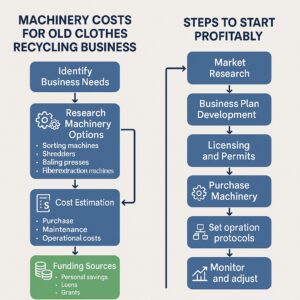
Primary Sorting and Preparation Equipment
- Industrial Textile Shredder: $25,000-$45,000
- Capacity: 500-2,000 kg/hour
- Purpose: Initial size reduction for efficient processing
- Automated Sorting Conveyor System: $30,000-$60,000
- Includes infrared sensors for fiber identification
- Separates natural fibers (cotton, wool) from synthetics
- Fiber Opening and Blending Machine: $40,000-$80,000
- Prepares materials for downstream processing
- Removes zippers, buttons, and other contaminants
Advanced Processing Machinery
- Carding Machine: $50,000-$120,000
- Aligns fibers for respinning
- Essential for high-quality recycled yarn production
- Non-Woven Production Line: $75,000-$200,000
- Creates insulation, padding, and industrial wipes
- Higher investment but versatile output options
- Baling and Compacting Press: $15,000-$35,000
- Prepares materials for transportation and sale
- Standardizes product dimensions
Total Initial Equipment Investment: $235,000-$540,000 for a medium-scale operation. Many regions offer green business grants and accelerated depreciation for recycling equipment.
Workforce Requirements for Efficient Operations
Staffing Structure for Medium-Scale Recycling Facility (5-10 ton/day capacity)
- Sorting and Quality Control Team: 6-10 workers
- Manual inspection and initial categorization
- Removes non-recyclable items and contaminants
- Machine Operators: 3-5 technicians
- Operates and maintains processing equipment
- Requires technical training in textile machinery
- Logistics and Collection Coordinators: 2-4 staff
- Manages collection partnerships with municipalities and retailers
- Coordinates transportation and inventory
- Sales and Marketing: 1-2 professionals
- Develops markets for recycled materials
- Secures contracts with manufacturers
- Management and Administration: 1-2 positions
- Oversight, compliance, and business development
Total Workforce: 13-23 employees depending on automation level and throughput. Consider phased hiring as operations scale, starting with 8-10 essential positions.
Profit Potential Analysis: Country-by-Country Breakdown
United States Market Opportunity
- Annual textile waste: 17 million tons
- Government incentives: Federal tax credits up to 30% for recycling equipment
- Revenue streams:
- Collection fees: $50-$150 per ton from municipalities
- Recycled fiber sales: $0.80-$1.50 per pound
- Specialty products: Up to $5 per pound for high-quality insulation
- Estimated annual profit: $250,000-$800,000 for medium facility
- Key advantage: Strong corporate ESG commitments driving demand
Canadian Recycling Landscape
- Extended Producer Responsibility: Mandatory in several provinces
- Carbon credit opportunities: Additional $20-$50 per ton
- Market differentiation: Premium for traceable, certified recycled content
- Estimated profit: $200,000-$600,000 annually
- Growing demand: From automotive and construction sectors
United Kingdom Textile Recycling Economics
- Landfill tax: £94.15 per ton (increasing annually)
- Collection infrastructure: Well-established charity partnerships
- Innovation grants: Available for chemical recycling technologies
- Profit potential: £180,000-£500,000
- Unique factor: Strong policy support through Resources and Waste Strategy
Australian and New Zealand Markets
- Australia: $15,000 grants available through National Product Stewardship Fund
- New Zealand: Waste Minimization Fund provides co-investment
- Geographic advantage: Proximity to Asian manufacturing hubs
- Combined profit estimate: AUD 300,000-700,000
- Emerging opportunity: Partnerships with outdoor apparel brands
United Arab Emirates Strategic Position
- Government initiatives: UAE Circular Economy Policy 2031
- Strategic location: Access to European and Asian markets
- Premium pricing: Recycled materials for luxury brands
- Tax benefits: 0% corporate tax in free zones
- Projected profit: $400,000-$900,000
- Growth catalyst: EXPO 2020 sustainability legacy projects
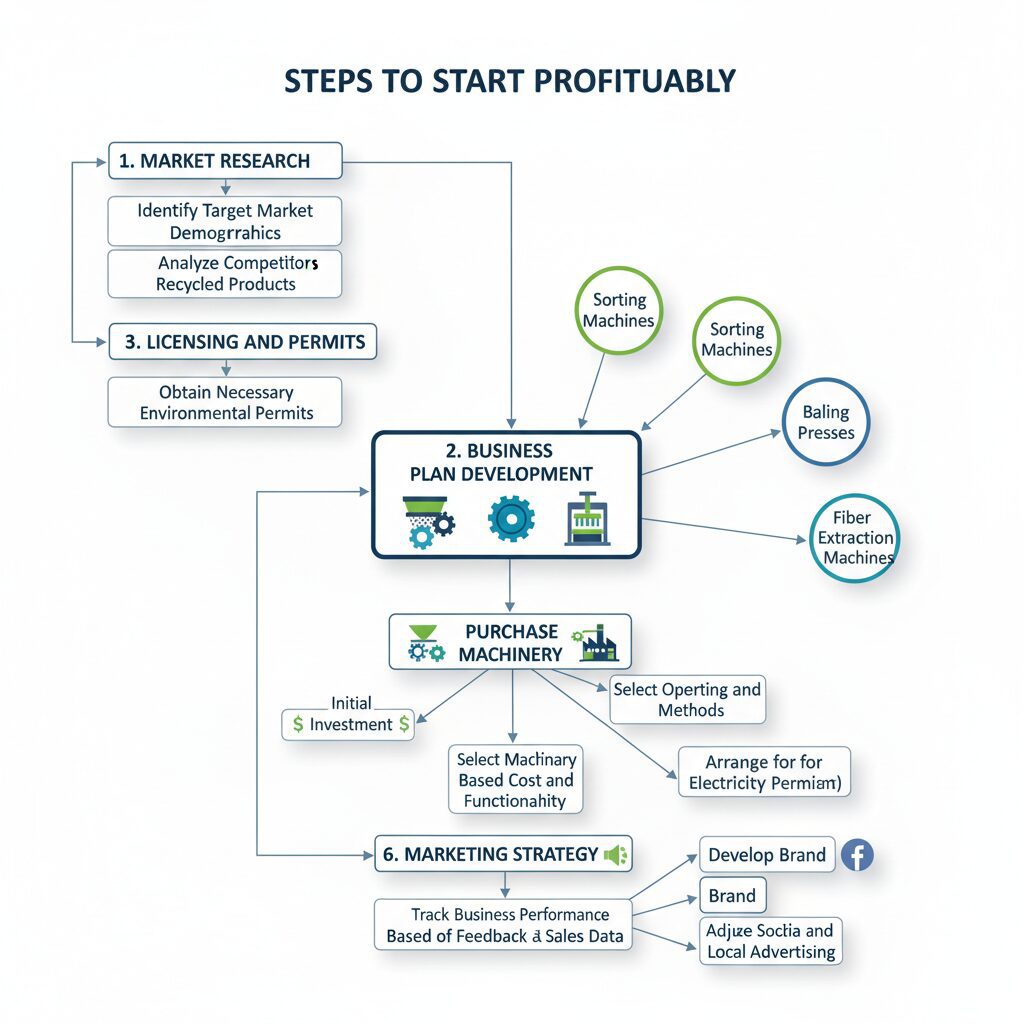
Step-by-Step Business Launch Strategy
Phase 1: Market Research and Business Planning (Months 1-3)
- Conduct local waste composition analysis
- Identify collection partners (municipalities, retailers, charities)
- Secure initial off-take agreements with manufacturers
- Develop comprehensive business plan with financial projections
Phase 2: Regulatory Compliance and Financing (Months 3-6)
- Obtain environmental permits and operating licenses
- Apply for green business grants and sustainable development funds
- Secure equipment financing through specialized lenders
- Implement quality certification systems (GRS, RCS)
Phase 3: Facility Setup and Operations (Months 6-9)
- Lease or purchase industrial space (10,000-20,000 sq ft minimum)
- Install processing equipment with manufacturer training
- Recruit and train specialized workforce
- Establish testing protocols for output quality
Phase 4: Scaling and Diversification (Months 9-18)
- Expand collection networks to neighboring regions
- Invest in specialized processing for higher-value products
- Develop brand partnerships for closed-loop programs
- Explore export opportunities for processed materials
Key Challenges and Strategic Solutions (textile recycling business)
Supply Chain Volatility Mitigation
- Develop multiple collection streams (post-consumer, pre-consumer, industrial)
- Establish long-term contracts with consistent suppliers
- Implement inventory management system for raw material buffer
Quality Control and Market Acceptance
- Invest in automated sorting technology for consistent fiber quality
- Obtain third-party certifications to build buyer confidence
- Create transparent tracking systems for material provenance
Regulatory Compliance and Reporting
- Hire environmental compliance specialist
- Implement digital record-keeping for audit readiness
- Engage with industry associations for policy advocacy
Financial Sustainability Strategies
- Develop multiple revenue streams (collection fees, product sales, carbon credits)
- Phase equipment investments based on cash flow generation
- Explore co-processing partnerships to share facility costs
Conclusion (Old Clothes Recycling Business)
The old clothes recycling business represents a triple-bottom-line opportunity—profitable, environmentally beneficial, and socially responsible. Success requires strategic location selection based on local incentives, appropriate technology investment matching market demand, and strong partnerships across the value chain. With global textile consumption projected to increase 63% by 2030, the market for recycled materials will continue expanding, offering early movers significant competitive advantages.
textile recycling business old clothes recycling machine price recycled textile profits USA start clothing recycling business textile recycling equipment cost old clothes recycling profit UK sustainable textile business plan recycling business profitability Australia cotton waste recycling machine textile recycling startup costs