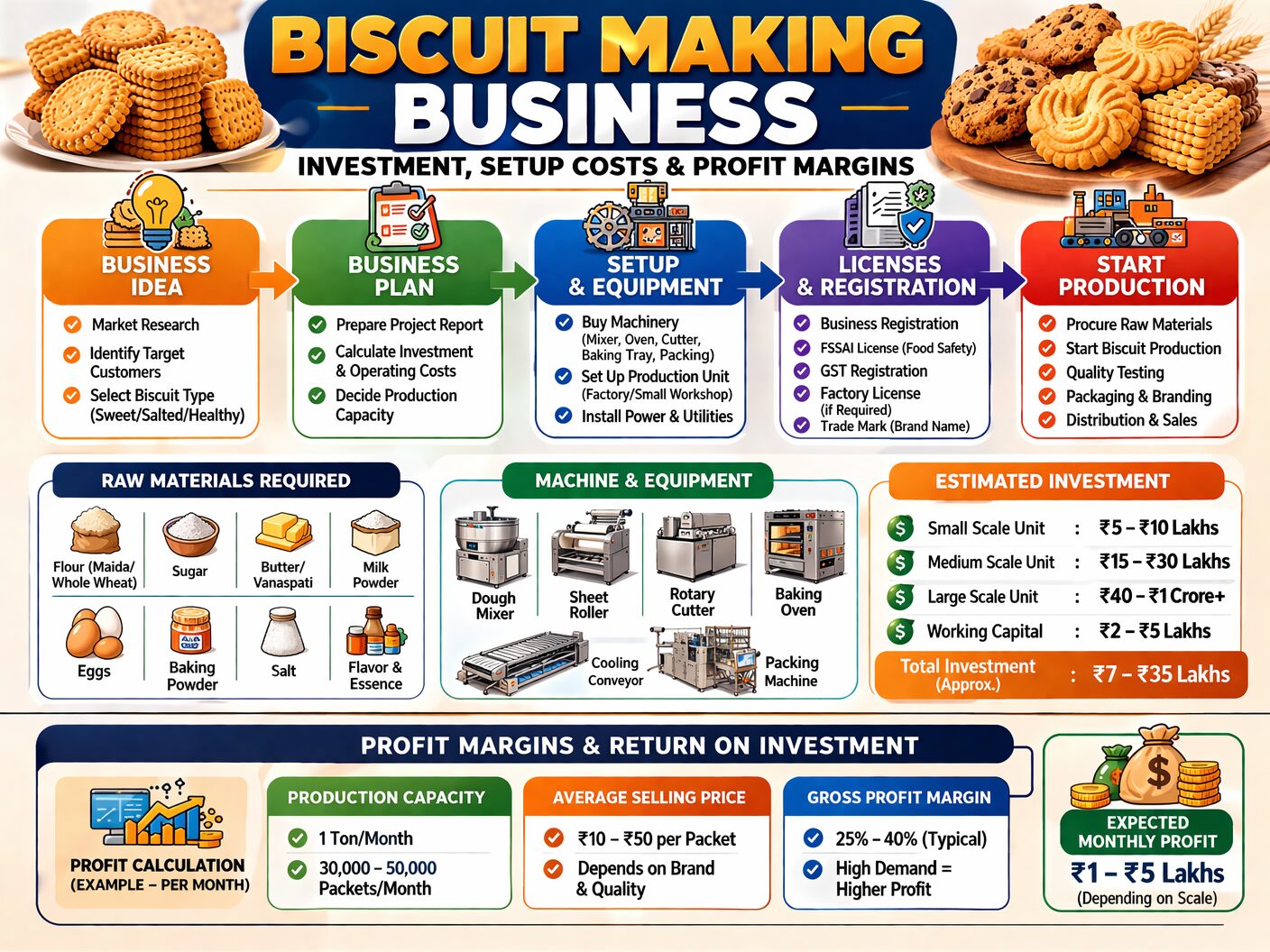
Starting a Biscuit Making Business: Complete Investment Guide
Launching a Biscuit Making Business represents a lucrative opportunity in the global snacking market, valued at over $134 billion. Whether you’re exploring biscuit business investment in India, USA, UK, Australia, New Zealand, or UAE, understanding startup costs, licensing requirements, distribution channels, and profit potential is critical to success. This comprehensive guide covers everything from biscuit plant setup costs (ranging INR 1.72 crore to $945,000 USD) to operational profitability (15-33.7% net margins), helping entrepreneurs navigate biscuit manufacturing licenses, supply chain logistics, and revenue projections across key international markets.
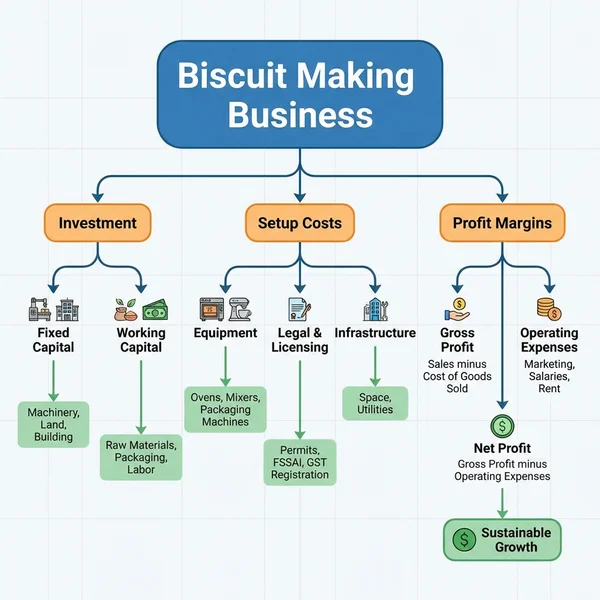
Biscuit Business Startup Investment: Breaking Down Capital Requirements
Total capital investment for a biscuit manufacturing facility varies significantly by country, automation level, and production capacity. In India, a moderately-sized unit spanning 1,500 sq ft requires INR 1,72,40,000 (approximately $2.06 million USD) total investment, structured as follows: INR 35,00,000 for building/infrastructure, INR 90,00,000 for plant machinery and equipment, INR 2,50,000 for furniture/misc., INR 2,50,000 for land, INR 90,000 for preliminary expenses, and INR 41,50,000 working capital (3 months).
In contrast, the USA, UK, Australia, and New Zealand markets typically require $945,000 USD in CAPEX for automated, high-volume operations (10K-100K MT/year capacity).[2] This breaks down into machinery/equipment costs ($400K-$500K), facility lease/construction ($22,000/month ongoing), installation/setup ($50K-$100K), and initial working capital ($100K-$200K).[2][3] UAE operations mirror USA/UK costs at AED 3.5-4.5 million (roughly $950K-$1.2M USD) due to stringent food safety regulations and premium real estate in Dubai/Abu Dhabi.
| Region | Total Setup Cost | Equipment CAPEX | Facility Cost | Working Capital | Break-Even Timeline |
|---|---|---|---|---|---|
| India | INR 1.72 Cr ($2.06M) | INR 90 Lakhs | INR 35 Lakhs | INR 41.5 Lakhs | 12-18 months[1] |
| USA/UK | $945,000 | $400K-$500K | $22K/month | $100K-$200K | 1 month (high volume)[2] |
| Australia/NZ | AUD/NZD 1.4M | AUD/NZD 600K | AUD/NZD 350K | AUD/NZD 450K | 8-12 months[3] |
| UAE | AED 3.5-4.5M | AED 1.8M | AED 1M | AED 700K | 10-14 months[4] |
Key cost drivers include automation level (semi-automatic vs. fully automated), raw material procurement (65-75% of OpEx), utilities (10-15% of OpEx), labor, and packaging materials (typically $0.12 per unit for compostable options).
Essential Licenses and Regulatory Requirements for Biscuit Manufacturing
Licensing varies by jurisdiction but centers on food safety compliance, factory registration, and tax registration. In India, secure an FSSAI (Food Safety and Standards Authority of India) License (₹5,000-₹10,000), state factory license via Department of Labour (₹2,000-₹5,000), GST registration (free), pollution clearance from state environmental board (₹10,000-₹25,000), and fire safety certificate (₹5,000). Total licensing costs: ₹27,000-₹50,000 ($324-$600 USD).
The USA mandates FDA registration, state food manufacturer license ($500-$2,000/year), local health department permit ($200-$1,000), and business license ($100-$500). UK requires Environmental Health Registration, FSA Food Business Operator (FBO) registration (free), local authority permit (£150-£1,000), and packaging/labeling compliance under UK Food Labelling Regulations. Australia needs Food Safety Supervisor certificate, state manufacturing license ($1,000-$3,000), local council approval, and FSANZ (Food Standards) compliance. New Zealand mandates Food Business Operator registration via local council (NZD 500-$2,000), Export Health Certificates if exporting. UAE demands Dubai Municipality Food Permit, Emirates Conformity Mark (ECAS), tenancy contract, and health and safety inspection (AED 5,000-AED 15,000).
Pro tip: Budget $5,000-$15,000 for initial licensing across all regions; renewal fees are typically 30-50% lower.
Distribution Strategy: From Factory to Consumer
Biscuit distribution determines market reach and profitability. Three models dominate:
Direct-to-Retail: Partner with supermarkets, convenience stores, and specialty shops. Margins: 35-40%. Requires sales team ($50K/year per person) and logistics fleet. Best for branded, premium products.
Wholesale Distributors: Sell to regional distributors who supply retailers. Margins: 20-30%. Lower upfront costs but less brand control. Ideal for scaling quickly across India, USA multi-state markets, or UK regional expansion.
Export & International: Target B2B bulk buyers (institutional buyers, food service), export markets (Middle East, Asia-Pacific). Margins: 25-35%. Requires export licenses, Incoterms negotiation (CIF, DDP pricing), and customs compliance.
For India, leverage FMCG distribution networks and e-commerce platforms (Amazon, Flipkart) for rapid scaling. USA/UK benefit from direct-to-consumer (D2C) websites and specialty food retailers. UAE focuses on expat retail chains (Carrefour, Lulu Hypermarket) and premium hotels/restaurants.
Operational Profitability: Revenue and Profit Margins
Biscuit manufacturing delivers impressive margins. At 1,500 kg/hour production capacity (typical mid-sized plant):
Revenue Model: Assuming 50% unit COGS of $0.75 against $4.50 wholesale price, gross margins hit 52.9-53.7%.[5] A facility producing 500 units/day at 250 working days/year generates 125,000 units, or 93.75 MT annually. At $2.25/kg wholesale, that’s $210,937 annual revenue.
Cost Breakdown (Annual OpEx):
- Raw Materials: 65-75% of OpEx = $136K-$158K
- Utilities (Power, Water, Gas): 10-15% = $21K-$32K
- Packaging: 8-10% = $17K-$21K
- Labor (8-12 staff): $240K-$360K (India: ₹15-20 Lakhs)
- Facility Lease: $264K/year ($22K/month)
- Depreciation & Maintenance: 5% of CAPEX = $47K
- Taxes, Insurance, Other: $50K-$75K
Total Annual OpEx: $635K-$788K
Net Profit: $210K revenue minus $635K-$788K OpEx = -$425K to -$578K Year 1 (pre-scale). However, scaling to 1,000 MT/year ($2.25M revenue) yields net profit of 15-25% ($337K-$562K), with ROI achieved in 2-3 years.
India-specific: Lower labor ($20K-$40K/year per worker) and real estate push net margins to 29.8-33.7% at scale.
Country-Specific Investment Insights (Namkeen Biscuit business)
India: Lowest entry cost (INR 1.72 Cr); fastest growth (biscuit market expanding 8-10% CAGR); government subsidies for food processing. Challenges: state-level excise taxes, complex labor laws.
USA: Mature market; requires $945K CAPEX but achieves break-even in 1 month with volume.[2] Focus on specialty/health-conscious niches (gluten-free, organic).
UK: Post-Brexit tariffs increase ingredient costs 5-8%; strong demand for premium/heritage brands. Investment: $850K-$1.2M.
Australia/NZ: High labor costs offset by premium pricing. Invest in export-ready certifications (halal, organic, non-GMO).
UAE: Luxury market; expat-driven demand; high real estate costs (AED 4.5M+). Partner with established distributors.
Namkeen Biscuit business Namkeen Biscuit business hindi Biscuit manufacturing startup costs Biscuit business investment India How to start biscuit factory USA Biscuit plant license UK Biscuit manufacturing profit margins Biscuit factory setup Australia Biscuit business New Zealand UAE biscuit manufacturing license Biscuit distribution strategy Biscuit making business plan