Unlock Your Potential: Become a P&G Distributor Today!
Becoming a distributor for Procter & Gamble (P&G) products can be a profitable business opportunity because the company owns globally trusted brands such as **Ariel, Tide, Gillette, Head & Shoulders, and Pantene. These products have constant consumer demand, making distribution and shipping a high-volume business. If you want to legally distribute P&G products, you must obtain the correct business registration, distributor approval, and shipping licenses.
What is a P&G Distributor Shipping Licence?
A P&G distributor shipping licence allows a business to legally store, distribute, and ship P&G products to retailers, wholesalers, or online stores. This licence ensures that the distributor follows trade regulations, logistics compliance, and tax rules.
Distributors usually handle:
-
Product bulk purchasing from P&G suppliers
-
Warehouse storage
-
Shipping and logistics
-
Retail and wholesale supply
-
Inventory management
Because P&G products include personal care, health, and household items, distributors must follow proper supply chain and shipping compliance regulations.
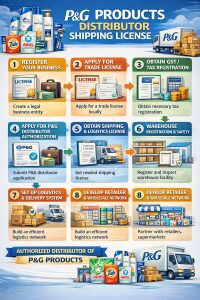
Step 1 – Register Your Distribution Business
The first step is creating a legal business entity.
Common business structures include:
-
Sole proprietorship
-
Limited liability company (LLC)
-
Private limited company
-
Partnership firm
Business registration typically requires:
-
Business name registration
-
Tax identification number
-
Business bank account
-
Legal operating address
Registering your business increases credibility when applying for brand distributorships and shipping licences.
Step 2 – Apply for a Trade Licence
A trade licence allows your company to legally sell and distribute consumer goods.
Requirements normally include:
-
Business registration certificate
-
Identity documents
-
Business address verification
-
Application form from local authority
The trade licence is essential because major companies like P&G only work with legally registered distributors.
Step 3 – Obtain a GST / Tax Registration
For product distribution and shipping, you must obtain tax registration such as:
-
GST registration (in many countries)
-
VAT registration (Europe)
-
Sales tax permit (USA)
Tax registration is necessary because distributors must:
-
Issue invoices
-
Collect taxes from retailers
-
File regular tax returns
Without proper tax registration, large brands will not approve distributorship requests.
Step 4 – Apply for P&G Distributor Authorization
Once your business is registered, you can apply for official distributor authorization from **Procter & Gamble.
Typical steps include:
-
Visit the official P&G supplier or distributor portal
-
Submit distributor application form
-
Provide company profile and documents
-
Share warehouse and logistics details
-
Submit financial capacity proof
P&G evaluates applicants based on:
-
Distribution experience
-
Financial capability
-
Market coverage
-
Warehouse capacity
-
Delivery network
After approval, you may receive a regional distributor contract.
Step 5 – Obtain Shipping and Logistics Licence
To legally ship products, your company may need a shipping or logistics licence depending on your country.
Common logistics licences include:
-
Freight forwarding licence
-
Transport permit
-
Warehouse licence
-
Import/export licence (for international distribution)
Shipping licences ensure compliance with:
-
Consumer goods transportation laws
-
Packaging regulations
-
Supply chain safety standards
If you plan to import products from international suppliers, you must also obtain an import licence and customs registration.
Step 6 – Warehouse Registration and Safety Compliance
Distributors must operate a licensed warehouse facility.
Warehouse requirements include:
-
Fire safety certification
-
Storage capacity
-
Inventory management system
-
Product safety compliance
For personal care products like **Head & Shoulders or Pantene, proper storage conditions are important to maintain product quality.
Many countries also require:
-
Warehouse inspection
-
Safety certification
-
Local municipality permits
Step 7 – Logistics and Delivery Setup
After licensing, you must build a distribution and shipping system.
Common logistics methods include:
-
Own delivery trucks
-
Third-party logistics companies
-
Courier shipping partners
-
Regional distributors
A good logistics network ensures fast delivery to:
-
Retail stores
-
Supermarkets
-
E-commerce warehouses
-
Wholesale markets
Efficient logistics improves your reputation with retailers and helps maintain consistent product supply.
Step 8 – Retailer and Wholesale Network Development
Once you receive distributor approval and shipping licences, the next step is building a retail network.
Potential buyers include:
-
Supermarkets
-
Cosmetic stores
-
Pharmacy chains
-
Online retailers
-
Wholesale markets
Because P&G brands like **Gillette and Tide have strong demand, retailers often prefer authorized distributors who can guarantee authentic products and stable supply.
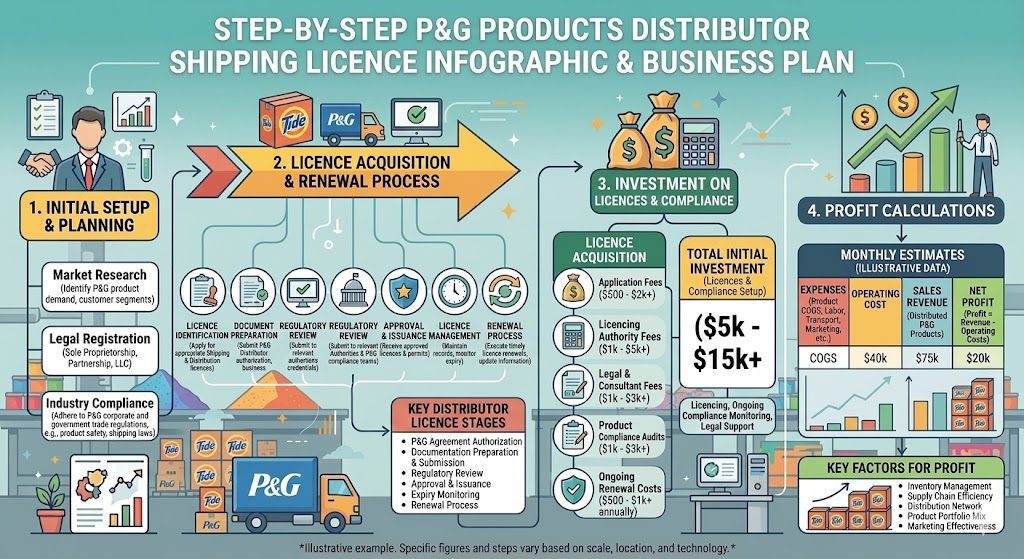
Investment Required for P&G Distribution Business
The investment varies depending on region and scale.
Typical cost areas include:
-
Distributor security deposit
-
Warehouse rent
-
Inventory purchase
-
Delivery vehicles
-
Licensing fees
-
Staff salaries
Small regional distributors may start with $20,000–$50,000 investment, while large distributors may invest $100,000 or more.
Benefits of Becoming a P&G Distributor
There are several advantages to distributing P&G products:
1. Strong Brand Demand
P&G products have global recognition and high sales volume.
2. Stable Business Model
Consumer goods like shampoo, detergent, and razors are daily-use products.
3. High Retail Network Opportunities
Thousands of retailers require regular product supply.
4. Long-Term Profit Potential
Distributors earn margins from bulk purchases and retail supply.
Important Documents Required
To apply for distributor shipping licences and P&G authorization, you may need:
-
Business registration certificate
-
Trade licence
-
Tax registration number
-
Warehouse agreement
-
Bank statements
-
Identity documents
-
Distribution experience profile
Providing complete documentation increases your chances of approval.
Final Thoughts
Starting a P&G products distributor shipping business can be a profitable opportunity in the consumer goods market. However, success requires proper licensing, strong logistics infrastructure, and official distributor approval from Procter & Gamble. registering your business, obtaining trade and shipping licences, building a warehouse system, and establishing a retail distribution network—you can create a scalable and long-term distribution business.
P&G distributor license how to become a distributor for P&G P&G products distribution shipping and logistics for distributors how to ship P&G products P&G distributor requirements P&G distributor registration international shipping license