
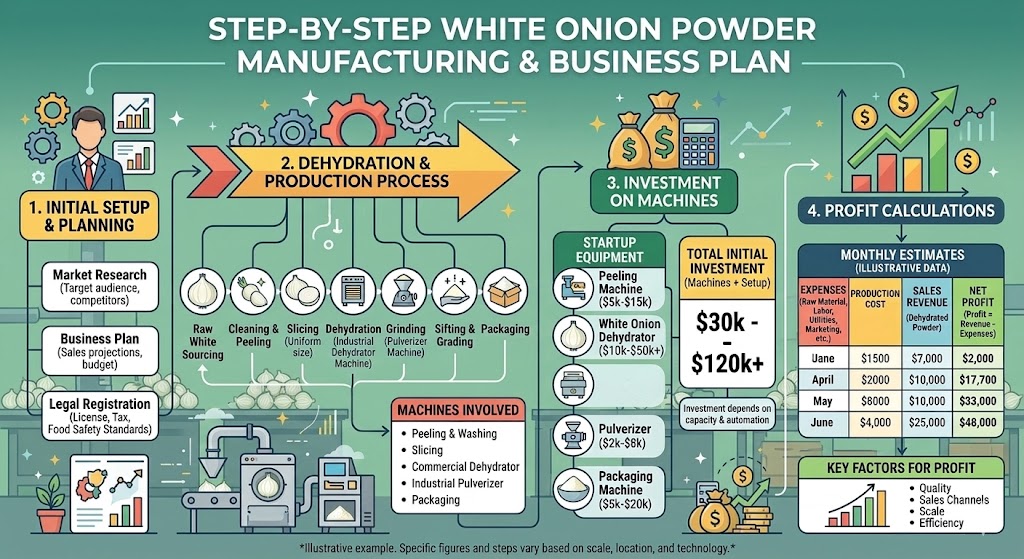
The Ultimate Guide to Starting Your White Onion Powder Manufacturing business
The white onion powder manufacturing business is a profitable agro-processing industry because onion powder is widely used in spice blends, snacks, sauces, instant foods, and restaurant cooking. Dehydrated onion powder has a longer shelf life than fresh onions and is easier to transport and export. Global demand is increasing due to the growth of the processed food industry.
According to market studies, the global dehydrated onion powder trade reaches about 150,000 metric tons annually with a value around $600 million, and the average export price is about $4 per kg.
This guide explains machines required, manufacturing process, machine investment, profit margin, and demand countries with prices.
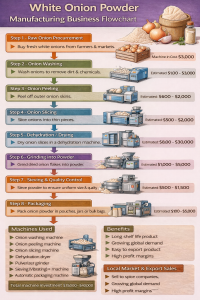
White Onion Powder Manufacturing Process
White onion powder is produced through a dehydration process where moisture is removed from fresh onions and then ground into powder.
Step 1 – Raw Onion Procurement
The first step is purchasing fresh white onions from farmers or wholesale vegetable markets. White onions are preferred because they have mild flavor and light color, which is suitable for food manufacturing.
Key points:
-
Buy onions in bulk during harvest season
-
Store them in ventilated storage areas
-
Select good-quality onions without damage
Usually 8–10 kg of fresh onions produce about 1 kg of onion powder.
Step 2 – Washing
Onions are washed to remove dirt, soil, and pesticide residues.
Machine used:
-
Onion washing machine
-
Bubble vegetable washer
Estimated machine cost:
$1,000 – $3,000
Clean washing is important for food safety standards.
Step 3 – Onion Peeling
After washing, the outer skin is removed.
Machine used:
-
Automatic onion peeling machine
Estimated price:
$800 – $2,500
Large factories use pneumatic peelers to increase efficiency.
Step 4 – Onion Slicing
Onions are sliced into thin pieces to help them dry quickly.
Machine used:
-
Onion slicing machine
Estimated cost:
$500 – $2,000
Thin slicing ensures uniform dehydration.
Step 5 – Dehydration / Drying
This is the most important step in onion powder production. Onion slices are dried in industrial dryers until most of the moisture is removed.
Common dehydration machines:
-
Tray dryers
-
Heat pump dryers
-
Mesh belt dryers
Typical machine cost:
$8,000 – $30,000 depending on production capacity.
Drying usually takes 6–10 hours depending on temperature and humidity.
Step 6 – Grinding
After dehydration, dried onion flakes are ground into powder.
Machine used:
-
Pulverizer grinder
-
Hammer mill
Estimated price:
$1,000 – $5,000
Grinding machines convert dehydrated onion flakes into fine powder used in seasoning and spice mixes.
Step 7 – Sieving and Quality Control
The powder is filtered through vibrating sieves to ensure uniform particle size.
Machine used:
-
Vibrating sieving machine
Estimated cost:
$500 – $1,500
Quality control ensures the powder is free from impurities.
Step 8 – Packaging
Finally, onion powder is packed in food-grade packaging.
Packaging types:
-
Plastic pouches
-
Glass jars
-
Bulk export bags (10–25 kg)
Machine used:
-
Automatic packaging machine
Estimated price:
$1,000 – $5,000
Proper packaging protects the product from moisture and contamination.
Machine Investment for Onion Powder Factory
| Machine | Estimated Cost |
|---|---|
| Onion washing machine | $1,500 – $3,000 |
| Onion peeling machine | $800 – $2,500 |
| Onion slicing machine | $500 – $2,000 |
| Dehydration dryer | $8,000 – $30,000 |
| Grinding machine | $1,000 – $5,000 |
| Sieving machine | $500 – $1,500 |
| Packaging machine | $1,000 – $5,000 |
Total machine investment:
$15,000 – $40,000
Small factories usually process 500 kg to 2 tons of onions per day.
Profit Calculation in Onion Powder Business
Example cost calculation per kg of onion powder:
| Cost Component | Amount |
|---|---|
| Raw onions | $1.5 |
| Electricity | $0.5 |
| Labor | $0.5 |
| Packaging | $0.5 |
Total production cost:
$3 per kg
Average selling price:
$5 – $7 per kg
Profit per kg:
$2 – $4
If a factory produces 5 tons per month, estimated profit can reach:
$10,000 – $15,000 monthly
Industry profit margins can reach 30–40% depending on quality and export demand.
Demand Countries for White Onion Powder
The biggest markets for onion powder are countries with large processed food industries.
Major importing countries include:
-
United States
-
Germany
-
United Kingdom
-
Japan
-
France
-
Canada
-
UAE
-
Australia
The United States alone accounts for about 25% of global onion powder imports, driven by the food processing and seasoning industries.
Asia-Pacific is also the largest production region, especially India and China, which supply much of the global market.
Onion Powder Export Price Chart
| Country | Average Import Price |
|---|---|
| USA | $5 – $7 / kg |
| Germany | $4 – $6 / kg |
| UK | $4 – $6 / kg |
| Japan | $5 – $7 / kg |
| France | $4 – $6 / kg |
| Canada | $4 – $6 / kg |
| UAE | $4 – $5 / kg |
| Australia | $4 – $6 / kg |
Global average export price is around $4 per kg, depending on quality and packaging.
Advantages of White Onion Powder Manufacturing Business
There are several reasons why this business is attractive for entrepreneurs.
First, onion powder has long shelf life, often up to 12 months if stored properly.
Second, the product is lightweight and easy to transport, which makes it ideal for export markets.
Third, the global processed food industry is growing rapidly, increasing demand for dehydrated vegetable powders.
Fourth, this business has high profit margins due to value addition from dehydration and packaging.
Conclusion (White Onion Powder Manufacturing business)
The white onion powder manufacturing business is a high-demand agro-processing industry with strong export potential. With an investment of $15,000 to $40,000 in machinery, entrepreneurs can start a small-scale production unit. The global market is expanding due to the increasing demand for ready-to-eat foods, seasoning mixes, and packaged snacks. By focusing on quality production, proper dehydration technology, and strong export marketing, this business can generate 30–40% profit margins and long-term growth opportunities.
white onion powder manufacturing white onion powder business onion powder manufacturing business dehydrated onion powder onion powder manufacturing food processing industry packaging machinery for food dehydrated vegetable powder spice manufacturing process food-grade packaging solutions