
1
The Ultimate Guide to Google Digital Marketing in 2026: Trends & Tips
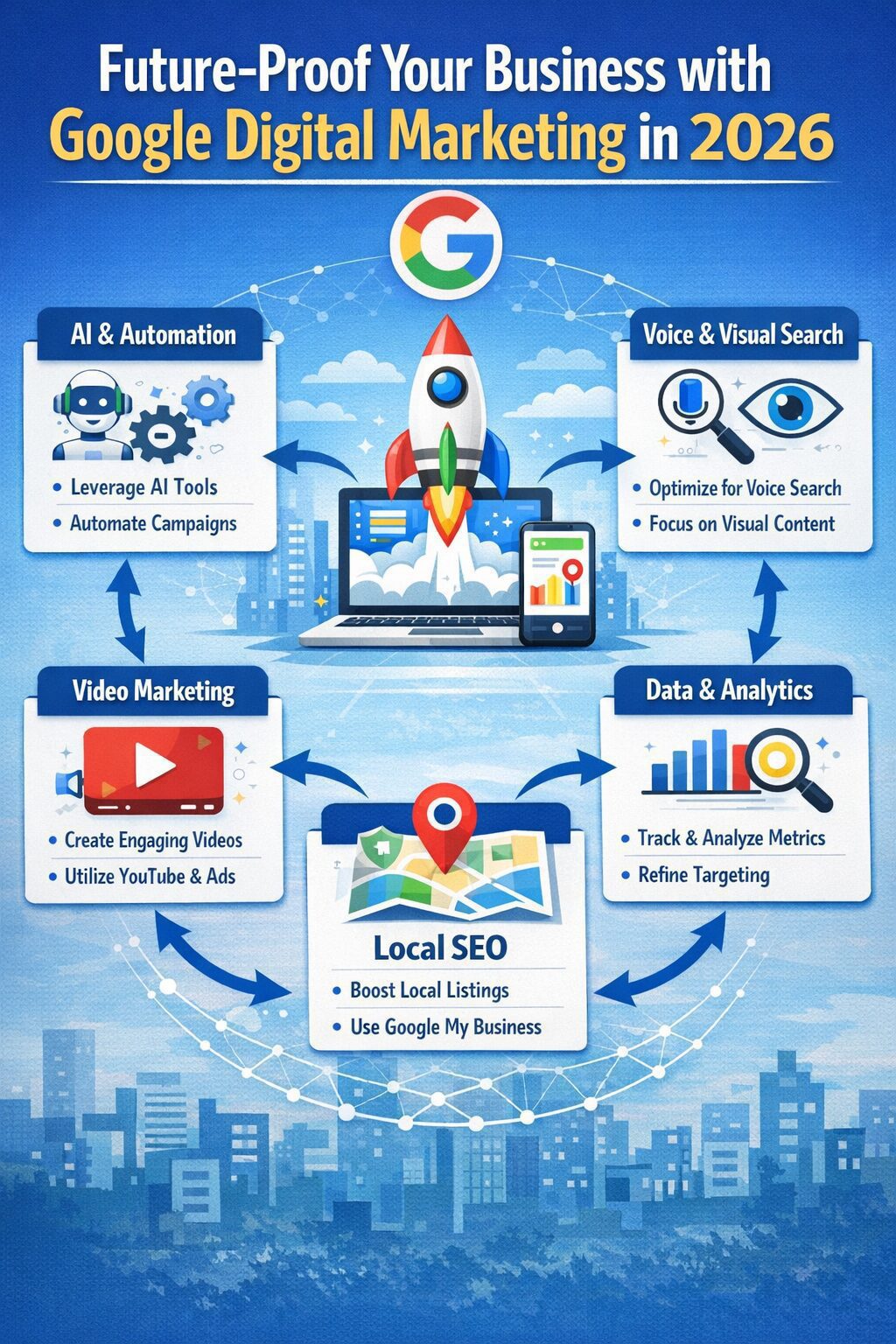
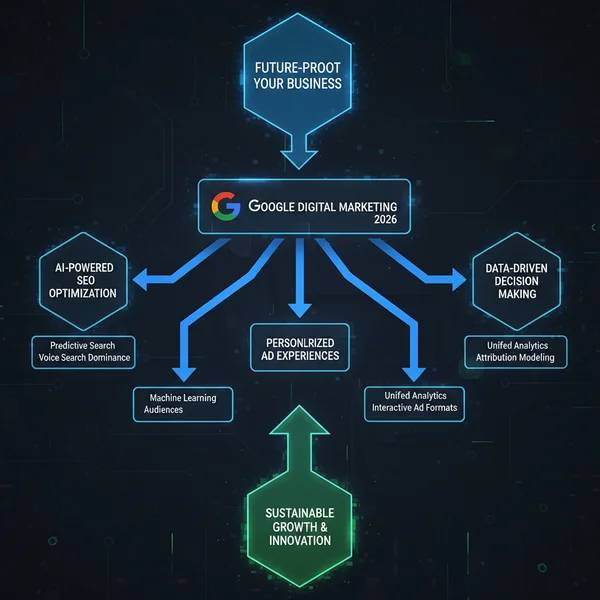
Google is central to modern digital marketing. Its ecosystem — Search, Ads, Analytics, YouTube, Display Network, Maps, and more — gives marketers powerful channels to reach intent-driven audiences. Below is a practical, up-to-date guide (2026) covering strategy, channels, tools, measurement, and best practices to get the most from Google for growth.
Overview & Strategy
- Start with business goals: brand awareness, lead generation, sales, retention, or local footfall. Translate goals to measurable KPIs (CPA, ROAS, CLTV, impressions, organic traffic).
- Audience-first approach: define buyer personas, customer intent at each funnel stage, and map keywords/content to those stages.
- Integrated funnel: combine paid (Google Ads), owned (website, YouTube channel), and earned (reviews, organic search) channels for consistent messaging and measurement.
- Lean experimentation: run small hypotheses (creative, bid strategy, landing page) and scale winners using automated rules and scripts.
Core Google Channels & Best Uses
- Google Search (Organic SEO)
- Focus on E-E-A-T (Experience, Expertise, Authoritativeness, Trustworthiness) for 2026: content should show real expertise, recent experience updates, and clear provenance.
- Keyword strategy: prioritize search intent (informational, commercial, transactional) and long-tail queries for higher conversion.
- Technical SEO: site speed (Core Web Vitals), structured data (schema), mobile-first indexing, crawl budget, canonicalization.
- Content: cluster topics around pillar pages, use helpful, actionable content, update evergreen content, and publish user-centric FAQs and how-tos.
- Local SEO: optimize Google Business Profile, generate reviews, include local schema, and maintain consistent NAP citations.
- Google Ads (Search, Performance Max, Display, Shopping, Discovery)
- Campaign selection:
- Search campaigns for high-intent, direct-response queries.
- Performance Max for omnichannel automated reach (good for scaled conversion goals; feed-rich assets improve results).
- Display & Discovery for upper-funnel awareness and remarketing.
- Shopping & Smart Shopping for ecommerce (use merchant center product feeds optimized with titles, GTINs, high-quality images).
- Bidding & automation:
- Use data-driven bidding (tCPA, tROAS) when conversion volume is sufficient. Combine with seasonality adjustments and conversion value rules.
- Test manual bidding for niche use-cases where automation performs poorly.
- Creative & assets:
- Provide multiple responsive search ad headlines and descriptions.
- For Performance Max, supply high-quality images, short/long videos, and audience signals.
- Measurement:
- Use conversion modeling and server-side tracking to compensate for browser privacy changes.
- Import offline conversions (CRM, phone calls) to close the loop.
- Campaign selection:
- YouTube & Video
- Use YouTube for brand storytelling, product demos, testimonials, and educational content.
- Ad formats: skippable in-stream, non-skippable, bumper ads, and video action campaigns for direct response.
- Organic growth: consistent upload schedule, strong thumbnails, watch-time optimization, and playlists for content sequences.
- Shorts: leverage short-form content for discovery but align content to broader channel goals (traffic, subscriptions).
- Google Display Network & Programmatic
- Use for remarketing, contextual targeting, and prospecting.
- Build segmented audiences (site visitors, cart abandoners, high-LTV customers) and tailor creative per segment.
- Avoid broad, untargeted display unless brand-awareness uplift is primary metric.
- Google Maps & Local Ads
- Local campaigns drive store visits and calls. Keep business profile accurate and post regularly.
- Local inventory ads and store pickup banners increase omnichannel sales for retailers.
Measurement & Analytics
- Google Analytics 4 (GA4)
- Adopt GA4 as primary analytics platform. Configure events and conversions that map to business KPIs.
- Use custom dimensions for deeper segmentation (user type, subscription tier).
- Set up consent-aware measurement and data retention policies.
- Tagging & Consent
- Implement Google Tag Manager for flexible event management and server-side tagging to improve data quality.
- Respect privacy: use consent management platforms and configure measurement to honor user choices.
- Attribution
- Move beyond last-click: use data-driven attribution where available, and complement with incrementality tests (holdout groups).
- Use experiments (A/B, geo-split) to measure lift from ads and content.
Creative & Content Best Practices (2026)
- Micro-moments & intent-matching: optimize content to answer immediate user needs (e.g., “best [product] for [need]”).
- Structured snippets & rich results: implement schema for FAQs, reviews, products, events to increase SERP real estate.
- Mobile-first creative: vertical video and portrait visuals perform better on mobile; ensure fast-loading landing pages.
- Personalization & dynamic creative: use dynamic remarketing and ad customizers to show tailored messages and prices.
Privacy, Compliance & Future-Proofing
- Prepare for continued privacy evolution: invest in first-party data (email lists, authenticated users), server-side tracking, and modeled conversions.
- Clean & centralize data: use a customer data platform (CDP) or centralized data warehouse to unify signals across Google channels and other platforms.
- Automation oversight: automation scales but requires guardrails; monitor quality metrics (CTR, conversion rate, CPA) and audit automated campaigns regularly.
Measurement of Success & Optimization Loop
- Define monthly/quarterly targets for conversions, CPA, ROAS, and organic traffic growth.
- Experimentation cadence: run 1–3 experiments per channel per month (creative, landing page, audience) and apply learnings.
- Reporting: create executive dashboards for high-level KPIs and granular dashboards for channel managers using GA4, Looker Studio, or Data Studio.
Quick Action Checklist (Practical Steps)
- Audit Google Business Profile and site technical SEO.
- Set up GA4 with key events and link to Google Ads.
- Launch targeted Search campaigns for top 10 commercial keywords.
- Run a 30-day Performance Max test with assets and audience signals.
- Implement remarketing lists and a 3-ad creative rotation.
- Collect first-party email and phone conversions; map to Google Ads for offline conversion imports.
Answer Engine Optimization (AEO) Generative Engine Optimization (GEO) AI-Powered Search Agentic Commerce Brand Presence Over Link-Building Zero-Click Search Optimization Hyperlocal & Proximity Signals AI-Native Creative Production Google Digital Marketing in hindi Google Digital Marketing kya hai Google Digital Marketing list



[…] platform that gathers all our brands into one powerful app,” Chandrasekaran wrote.For consumers, the app brings together the group’s airline Air Asia, hospitality company Indian Hotels Co., […]